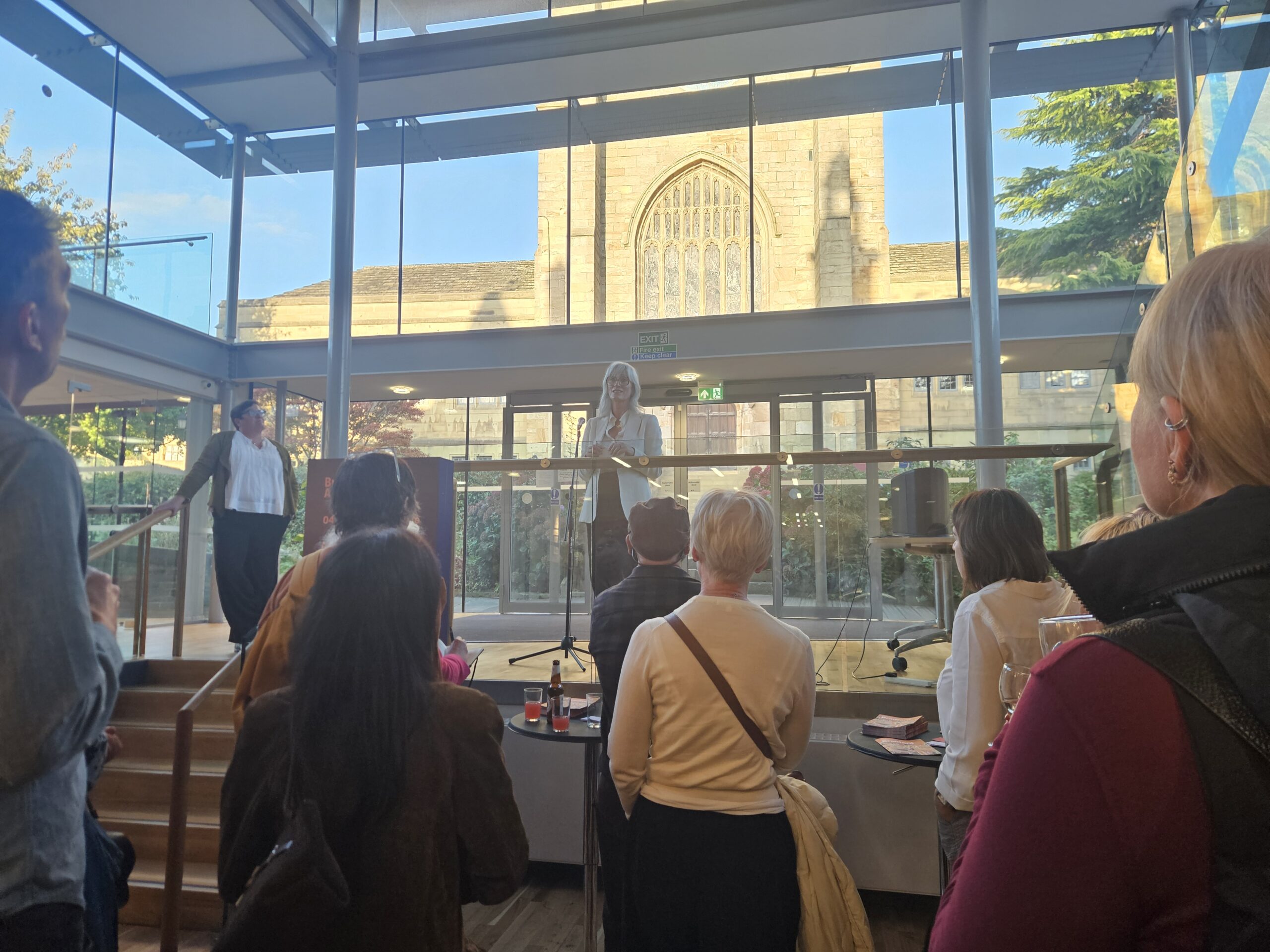
Animo PR Founder, Anita Morris, was invited by Bradford Council to speak at the reception to welcome delegates from all over the UK to the City Nation Place 2026 conference. Her words are published here.
At Animo we’ve worked in Bradford, and with places like Bradford, for many years: places that can be overlooked, misunderstood, or where people think they already know the story.
When a place changes, what makes its reputation change too?
We started looking at this more closely because we could see something shifting in Bradford.
In the media, on social media, in Reddit conversations and elsewhere, the way people were talking about the city seemed to be changing.
Not everywhere, and not all at once. But enough to make us curious about the gap between an older reputation and what people were beginning to see and say now.
So we started a small pilot – looking more closely at that conversation and speaking to people who know the city well.
Bradford felt like the right place to begin. Our work around Bradford 2025 and city-centre regeneration, including City Village, meant we were seeing the change up close, and hearing how people were talking about it at the same time.
One thing that’s become clear very quickly is that a place doesn’t have one reputation. Different people carry different versions of it.
They bring memories, things they’ve heard, things they’ve seen, sometimes experiences from years ago. Someone I spoke to last week described some of those memories as “scars”.
And those older narratives can be very hard to shake off.
Even when a place is changing, people may still be carrying a version of it formed five, ten or twenty years ago.
And it isn’t always outsiders who hold those older views. Sometimes people coming into a place can see change and opportunity more readily than people who have lived with its history for years.
That is part of the gap we’re interested in.
What does it take for people to update what they think they know?
What kept coming up was the difference between the Bradford people expected and the Bradford they actually encountered.
One person we spoke to had been showing a first-time visitor around the city. The visitor photographed the architecture and sent the pictures to a WhatsApp group, asking where they thought he was.
They guessed Oxford, Durham, Bath.
Nobody said Bradford.
When he told them, the response was basically: no way.
And we found versions of that same reaction in media coverage and social conversation too — people saying, in one form or another, “I hadn’t realised”.
Sometimes the gap closes when people experience a place for themselves, whether for the first time, or by coming back and seeing it differently.
We also kept coming back to the role of big, visible moments – the point at which change becomes hard to miss.
Bradford Live opened last year, but the story behind it goes back around 25 years. Its importance for reputation may be that it gives people something concrete to point to – visible evidence that the city is changing.
Bradford 2025 did something different again. It brought national attention on a scale most places won’t have: a government-backed UK City of Culture year, with partners including the BBC, giving people reasons to come, look, take part and talk about the city.
Most places won’t have a moment of that size. But they will have their own moments – a development, an opening, an investment, a cultural event – something that gives people a reason to look again.
So perhaps the useful question for communicators isn’t simply: what’s our story?
It’s: whose view are we trying to change, what might give them reason to look again, and what do we want them to do differently as a result?
Because the interesting bit is what happens next.
Does a change in the narrative begin to change perception?
And does that, in turn, influence what people do – whether they visit, come back, recommend, apply, invest, move or stay?
That’s the part we want to understand better.
And it’s also where I think communications has a clear role.
Not to invent change. To help real change be seen, understood and talked about.
Bradford is our first test.
We’re doing this partly to inform our own work – to understand more about the gap between change on the ground, the stories people carry, and the point at which perception begins to move.
We’re sharing what we learn with people here in Bradford who are already contributing to that change.
From here, we want to try the same thinking in other places – neighbourhoods, towns and cities, some we already know and some completely new to us.
The point is to see what we learn in other places, what is similar, what is different, and what that tells us about how reputation changes.
I suspect many of you work in places where there is a gap between what is changing and what people still think they know.
We’re interested in what that gap looks like in different places. What memories or old assumptions are hardest to shake. What gives people a reason to look again — or to come back. And what happens when the narrative begins to change.
And if this is a question you’re interested in too, we’re very happy to share what we’re learning.
Because Bradford is only the first test.
What we really want to understand is: what actually changes the reputation of a place?